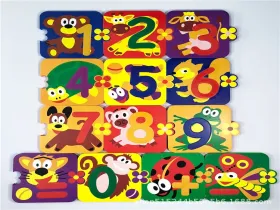
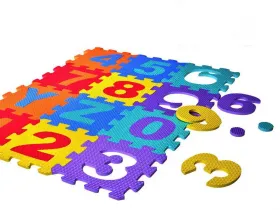
A pilot order for laser-cut EVA foam is not a small version of a production run. It is a test of how faithfully a factory reproduces the detail you drew: hairline gaps between fingers, tight inside corners, thin stems, interlocking teeth, engraved lettering. If you spend your sample budget on five variations of one simple shape, every piece comes back looking acceptable and you learn nothing. If you spend it on parts that stress different limits of the cutting process, one round of samples tells you which supplier to trust with the full order.
Below is how we at Fulikai, a Shenzhen EVA foam products manufacturer, suggest buyers assemble that first batch — and what each variant actually proves.
Start with the decision that shapes everything: laser or stamping
We produce parts in a wide range of shapes and colours by both stamping and laser cutting, working from customer drawings or physical samples. Which one you choose changes what your pilot order needs to contain.
| Factor | Laser cutting | Die stamping |
|---|
| Tooling needed before the first piece | No cutting die. The drawing drives the cutter directly. | A steel die must be made for your shape. |
| Tight inside cuts and fine internal detail | Well suited; internal windows and narrow slots can be cut without a separate die feature. | Depends on whether the die can hold thin blades and stay aligned. |
| Very high volume, single fixed shape | Cycle time per piece becomes the constraint. | Faster per piece once the die exists. |
| Design still moving between rounds | Easy — revise the file, cut again. | Every revision means a new or modified die. |
| Cost behaviour as quantity rises | Unit cost stays comparatively flat. | Die cost is amortised across the run. |
The practical rule: use a laser-cut pilot order when your design still needs to move, or when the geometry is too fine for a die to hold. Keep stamping in mind for the shape that survives the pilot unchanged and goes into volume. Our service team reviews submitted drawings and proposes adjustments — including linework changes — before anything is cut, because a line that looks right on screen often cannot be held in 4 mm foam.
Variant one: the silhouette with fine negative space
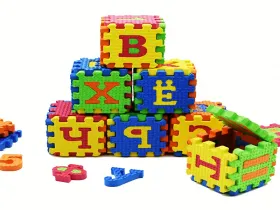
This is the piece your product actually depends on, and it is where most pilots fail. Send a shape that contains thin protrusions and small closed cut-outs: the fingers of a cheering hand, the tail fins of a dinosaur bath puzzle, the counters inside letters such as A, O, R and B.
What you are testing:
- Kerf control. The laser removes a narrow band of material. On a closed shape that band comes out of your part, so a letter cut to its exact outline prints slightly loose in the mating groove. Ask for samples cut at two kerf compensations and measure both.
- Corner scorching. Where the beam slows down to turn, foam edges darken. This shows up on inside corners first and is visible against light colours.
- Thin-feature integrity. A 2 mm-wide finger must survive ejection from the sheet, packing, and a transit to your office without tearing at the base.
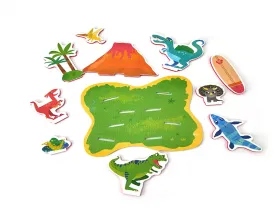
Our custom foam cheering hands are a useful reference here: they are die-cut to customer sizes and show what fine outline work looks like in coloured EVA before any print goes on top. The dinosaur bath puzzle playset is the other extreme — a set of interlocking pieces where every contour has to mate with its neighbour.
Variant two: the same silhouette at your target thickness
A sample cut from whatever sheet is on the bench tells you about the outline, not about your product. Request the second variant as the identical shape at the density and gauge you intend to sell.
Thickness changes three things at once: how much material the beam passes through, how the edge looks after cutting, and whether fine features feel solid or floppy in hand. A cheering hand cut thin flexes and tears; a garden kneeling pad cut thin stops being a kneeling pad. Our high-density EVA garden kneeling pad exists precisely because density, not just shape, decides whether a flat foam part does its job.
Colour belongs in this variant too. Our colours are formed during one-step foaming with added colour masterbatch, so the pigment runs through the sheet rather than sitting on the surface. That matters for cut parts: a through-dyed sheet keeps its colour along the exposed edge, while a printed surface layer leaves a pale line wherever the laser passes. Tell us your destination country when you specify the material and we will recommend raw materials matched to the standards that apply there.
Variant three: the cut combined with your decoration
A clean silhouette is only half of most products. The third variant should carry your artwork, so you see how printing behaves on a laser-cut edge rather than on a straight one.
We use self-developed heat-transfer printing with multi-pass white-base layers, which keeps the underlying foam colour from showing through the print and lifts colour saturation. On a cut part, the question is whether ink holds at the border where the printed face meets the cut edge, and whether the heat of transfer distorts a thin feature nearby. Screen printing behaves differently on the same part, so if your artwork allows both methods, print one variant each and compare.
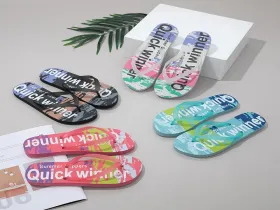
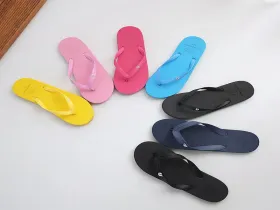
If your design includes a cut-out logo — a mark removed from the material instead of printed onto it, as in our hollow-out logo flip-flop work — this is also the variant where you check whether the cut mark stays crisp after printing and use.
Variant four: an assembly or mating pair
If your product has two laser-cut parts that fit together, a pilot order containing only single loose pieces cannot tell you whether the fit works. Send a pair: puzzle pieces that interlock, a tray and its insert, a base and its lid.
This is where kerf stops being a measurement and becomes a product decision. Cut both halves to nominal dimensions and the assembly comes out loose; compensate on one side only and you get a joint you can actually assemble by hand. The foldable bath puzzle we developed for the US brand Skip Hop is a good illustration of why this round matters: it needed screen printing on one face, heat-transfer printing on the other, and double-sided lamination fitted precisely enough to fold — requirements that took several sampling rounds to settle before anyone trusted a production order.
Variant five: the part you intend to buy in volume
Include one piece from an existing category you are seriously considering, cut and finished to your specification. This is not about detail; it is a rehearsal for the order itself — packaging, colour match, labelling, and whether the part arrives at your warehouse in saleable condition.
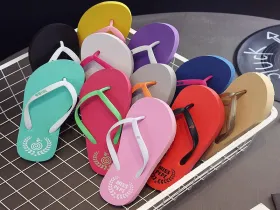
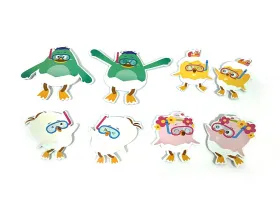
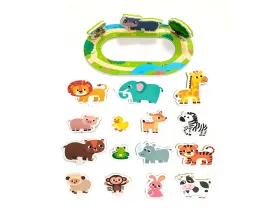
Useful places to start, depending on your channel: custom promotional flip flops for giveaway and event programmes, wholesale EVA educational toys for retail and cross-border listings, and surfboard and SUP traction pads for watersports ranges.
How to run the pilot so one round is enough
Send drawings, not just samples. A physical sample forces us to reverse-engineer tolerances you never stated. A drawing with your critical dimensions marked lets us quote realistically and flag what cannot be held before we cut.
Label every variant. Mark each piece with its thickness, density, colour and kerf compensation on the backing sheet or in a packing list. Unlabelled samples are the most common reason a second round is needed.
Put the detail-critical pieces on top of the pack. Foam parts stacked in a carton shift in transit, and thin features break at the corners. Ask for stiffening between layers if your pilot includes fine cut-outs.
Ask what the factory will change. A supplier who returns your drawings untouched is not reviewing them. We return linework suggestions with the first samples; that review is part of the service, not an upsell.
On timing: sample plates are produced in a short window and cost only a few hundred dollars, so five variants in one order is normally worth more than a single "safe" piece. Plate-making for printed designs is fast — confirm the exact turnaround for your artwork when you request the quote — and bulk production follows once you sign off the approved sample. Payment terms on custom orders follow our standard process: a 30% deposit when the contract is signed, with the balance after pre-shipment inspection.
Before anything ships, every part passes through our in-line testing and full manual pre-shipment inspection, and we support third-party inspection and buyer factory audits. That discipline starts at the pilot stage: the pieces you approve now are the reference for everything that follows.
Send your drawings or a physical sample to Fulikai's enquiry page, or call +86 13827489472. Shenzhen Fulikai Packaging Products Co., Ltd. has been making custom EVA foam products since 2008, exporting to Japan, South Korea, Europe and the United States.