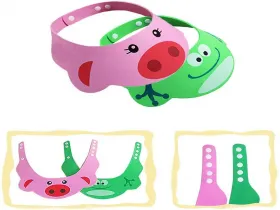
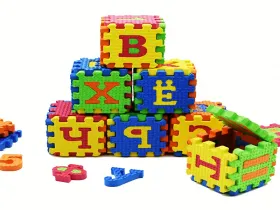
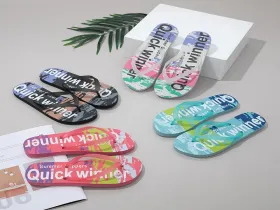
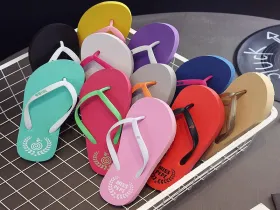
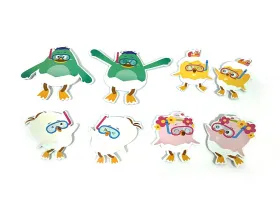
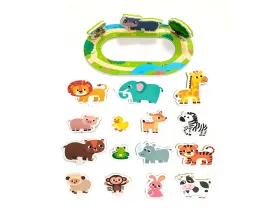
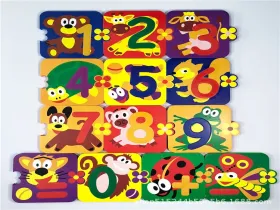
A cross-border seller who puts bath puzzles, interlocking mats, promotional flip-flops and cheering hands on one purchase order is asking a different question from a buyer sourcing a single item. The risk is not whether one SKU can be made; it is whether one factory can hold the same colour, the same print quality and the same delivery date across every line in the container. That depends on which process steps your supplier keeps inside its own plant.
Here is the working list we use with buyers consolidating several SKUs at one EVA foam products manufacturer: which steps have to sit under one roof, which ones a factory can safely buy in, and what to ask before you commit a mixed order.
Foaming and colouring: the step that decides whether your SKUs match each other
EVA sheet is rarely bought off a shelf in the exact shade on your spec. Colour is introduced during foaming, with masterbatch mixed so the pigment runs through the whole sheet instead of sitting on the surface. When a factory controls EVA foam colour matching itself, a mat panel and a bath puzzle piece from different batches can be drawn from the same colour recipe. When the sheet is bought in, each SKU may land on a different lot from a different compounder, and your brand colour drifts across the set.
This bites harder on consolidated orders than on single-SKU orders. One product can absorb a shade that is close enough. Six products sitting side by side in the same retail planogram cannot — shoppers compare them directly. Ask whether the supplier foams its own material, and whether the masterbatch batch record follows your order across SKUs.
Cutting, stamping and laser work: keep it where the tooling lives
Custom shapes come from die stamping and laser cutting of customer drawings or samples. If the cutter is a subcontractor, your die travels with it, along with the tolerance disagreement between whoever designed the part and whoever cuts it.
Fulikai's Shenzhen plant runs its own lines for foaming, cutting, stamping and laser processing across more than 3,000 square metres. A die opened for a bath puzzle and a die opened for its matching tray sit in the same building and can be adjusted against each other. The service team also reviews incoming drawings and proposes changes to details such as linework before tooling is cut — which only helps if the people reviewing the drawing are the people running the machine.
Printing: the step most often bought in, and the first one to show a problem
Print defects are the most visible failure on a foam product, so it is worth knowing how your supplier prints. Fulikai uses self-developed heat-transfer printing with multi-pass white-base underprinting, which stops the underlying foam colour from showing through the artwork and lifts saturation on darker sheets.
Plate-making speed belongs to the same question. A factory that makes its own plates can push a design change through in days rather than weeks; Fulikai quotes 5–7 days for plate-making, with sample plates at modest cost, so a seller testing several artwork variants before committing to bulk does not have to re-quote the whole order each time.
One caution on numbers: our own pages state both a five-day plate service and a 5–7 day window. Read either figure as an estimate for your specific artwork and sheet size, and confirm it in writing against your drawing rather than treating a marketing number as a commitment.
Inspection: one standard has to cover every line in the container
A consolidated order is inspected SKU by SKU. Fulikai's production process includes 16 types of tests covering colour fastness, tensile strength, ink environmental testing and children's product safety, followed by full manual inspection before shipment, with defective items rejected rather than quietly reworked. Third-party inspection is supported; the factory holds audit reports from Coca-Cola, Walmart and Sedex, and accepts buyer audits.
For a seller consolidating SKUs that structure buys something concrete: one inspection standard across all lines, one set of test reports, and one point of contact when an inspector flags something. If part of the order was subcontracted, you usually inherit two inspection regimes and an argument about which one applies.
What a supplier can reasonably buy in
Not everything belongs inside the fence. Resin and masterbatch come from upstream partners; Fulikai keeps long-term agreements with material suppliers and recommends compounds that meet the standards of the destination country once you say where the goods are going. Freight is another area where specialists do better work — shipments go through Debon Logistics to a designated destination, with staff assigned to track the order end to end.
The dividing line is simple: bought-in steps should be inputs and transport, not the steps that set your product's appearance, dimensions or safety documentation.
Questions to put to any supplier taking a mixed order
- Do you foam your own EVA sheet, and can you hold one colour across all my SKUs?
- Are the stamping dies and the laser cutter in the same building as foaming and printing?
- Who makes the print plates, and how long does one revision take?
- Which tests run per SKU, and do I get one inspection report covering the whole shipment?
- Which certificates apply to my specific items and destination market? CE, EN-71, FDA, RoHS, SGS and REACH coverage differs product by product, so ask for the report that matches yours.
- What happens between drawing and deposit? Fulikai's published flow runs consultation, quotation, design drafts and renderings, mould opening and print moulding, signature confirmation, then a 30% deposit on contract signing.
How this looks in practice
A US brand came to us with a foldable bath puzzle that needed screen printing on one face and heat-transfer printing on the other, double-sided lamination for precise fitting, and foldable packaging. The incumbent supplier declined the job; after roughly half a year of failed sampling elsewhere, the brand reached out. Our R&D team finished the sample ahead of the week it had promised, and the order grew into additional product lines.
That project is a small version of the consolidation question: one product with four processes stacked on it only works when every process sits in one place. Multiply it by six SKUs and the rule does not change.
Before you send the drawings
Send the drawing, the target market and the full SKU list in one message. A supplier that foams, cuts, prints and inspects under one roof can answer in a single reply which items share a sheet and a colour recipe, which plates can be combined, and what a realistic delivery window looks like for the order as a whole — bulk production is quoted at within 15 days after approval, with capacity reallocated when an urgent line needs it. A supplier who cannot answer those questions in one voice is probably splitting your order between workshops.
Send your SKU list and drawings through custom EVA foam manufacturing, or contact us on +86 13827489472.